Developers selling off-plan tend to treat renders and 3D tours as competing line items: pick one, save on the other. They aren't competing. They answer different questions a buyer is asking at different moments, and the cheapest mistake is using one where the other belongs.
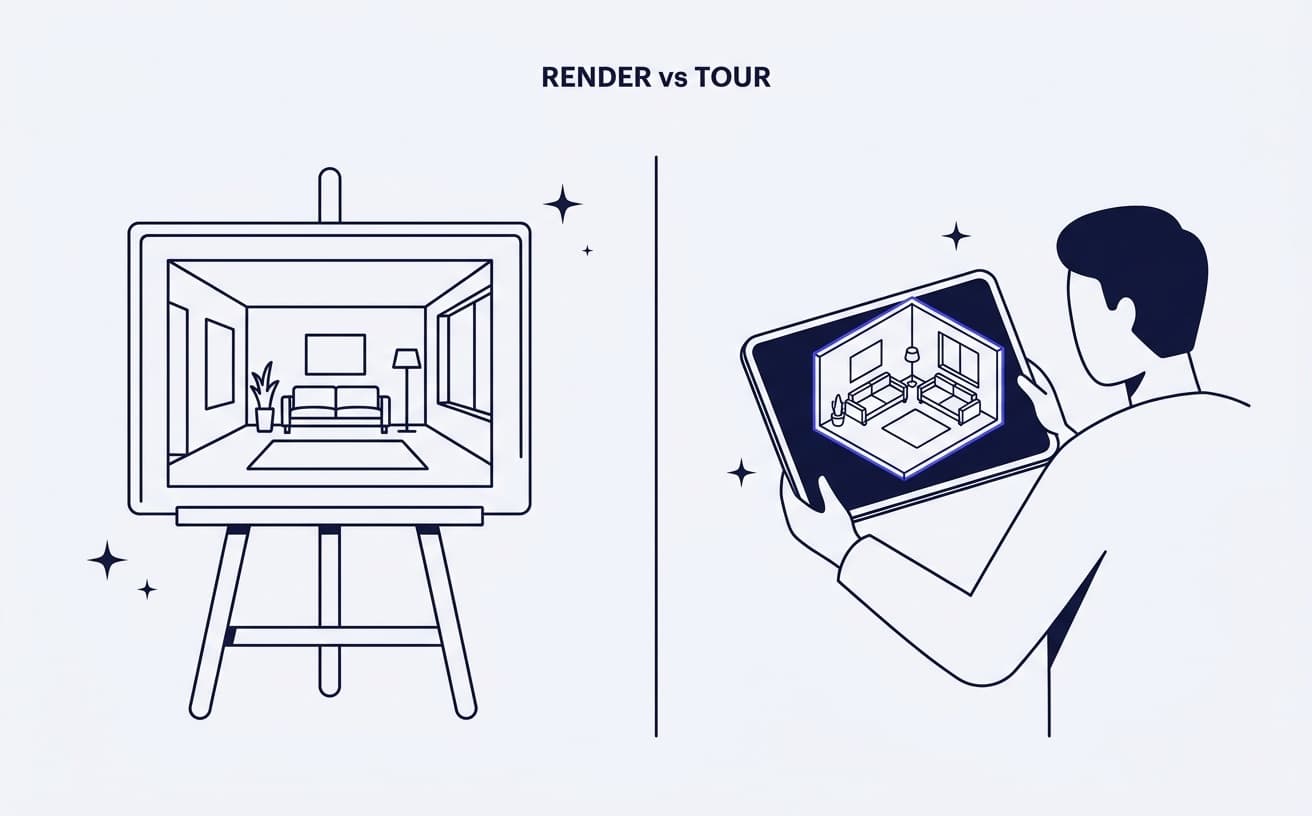
A render sells a feeling. A tour answers a doubt. Knowing which job you need done tells you where the money should go.
What a render is good for
A still render is a controlled image. You decide the light, the angle, the styling, the time of day. That control is exactly the point: it's the most persuasive way to show a space that doesn't exist yet looking its best.
Renders earn their keep early in the journey, when a buyer is forming a first impression and deciding whether this development is worth a second look. They work on a billboard, in a brochure, at the top of a listing, in the first slide of an investor deck. They set the aspiration.
They also scale down well. A hero render survives being cropped to a social ad, a thumbnail, an email banner. That portability is part of why renders remain the workhorse of top-of-funnel property marketing: one strong image does a dozen jobs.
Where they fall short is the moment a buyer stops admiring and starts interrogating. A render decides the framing for them. It shows the corner the buyer wants to see only if you chose to show it. And buyers know that a hero render is the best possible version of the room, which quietly caps how much trust it can carry on its own.
What a real 3D tour is good for
A walkable tour gives up control and gains credibility. The buyer chooses where to look. They can turn around, check the wall behind the camera, see how the kitchen relates to the living room, and judge whether the second bedroom really takes a desk and a cot.
That freedom is what makes a tour persuasive later in the journey, when a buyer has narrowed to a shortlist and is doing the quiet, suspicious work of talking themselves out of it. A tour answers the questions a render can dodge:
- Does it actually hold together as a home, or is it a set of nice individual shots?
- How big does it feel when I move through it rather than look at a flattering wide angle?
- What did they not want me to see? A tour that lets you look everywhere implies there's nothing to hide.
There's a demand story behind this too. The National Association of Realtors has reported that a majority of buyers now want to see a virtual tour on a listing, yet by its own count around 94% of listings still don't carry one. For an off-plan developer, that gap is the opportunity: the format buyers ask for is still rare enough to be a differentiator rather than an expectation.
The trade-off is that a raw tour, with no styling and harsh light, can undersell a genuinely good space. Freedom to look around includes freedom to land on the least flattering view.
Where each fits in the buyer journey
The clearest way to stop overthinking this is to map each format to the job the buyer is doing at that moment.
| Buyer stage | The question in their head | Best format | Why |
|---|---|---|---|
| Discovery | "Is this worth a look?" | Render | Controlled, aspirational, portable across ads and brochures |
| Consideration | "Could I picture myself here?" | Render, plus a tour link | Emotion pulls them in; the tour offer signals confidence |
| Verification | "Does the reality match the pitch?" | 3D tour | Freedom to inspect builds the trust a sale needs |
| Reassurance after enquiry | "Did I read that right?" | 3D tour | They revisit to confirm, not to be sold to again |
Read top to bottom and the logic is obvious: renders open the conversation, tours close it. Trouble starts when a format is asked to work outside its stage. A tour buried on a landing page nobody reaches wastes your most convincing asset. A render doing duty as proof, at the point a buyer wants to inspect, invites exactly the suspicion it can't answer.
Cost and turnaround, honestly
Renders and tours don't just cost differently; they cost differently in shape, and that changes how you budget.
A render is priced per view. You pay for a fixed number of angles, and every extra hero shot is another line item. The spend is front-loaded into art direction: styling, lighting, the revision rounds where you nudge a sofa or warm the light. Turnaround runs from days to a couple of weeks per image depending on how much polish you want.
A tour is priced closer to per space. You're paying to build a navigable environment rather than to compose a single frame, so the marginal cost of one more vantage point is low once the model exists. That makes a tour the more expensive asset up front for a single room, and the better value as the space grows, because a buyer walking a whole flat replaces the five or six renders you'd otherwise have commissioned to cover it.
The practical read: for a one-off hero image on a billboard, a render is cheaper and faster. For anything a buyer needs to explore in full, a tour usually costs less than the pile of renders it makes redundant, and it keeps earning across the sales cycle instead of being a fixed set of frames. Neither is the "budget" option in the abstract. The cheap choice is the one that matches the job.
Common mistakes to avoid
A few patterns waste money reliably, whatever the format:
- Rendering every room to the same hero standard. A kitchen and a living room deserve the treatment. A utility cupboard doesn't. Spread the same budget across three great renders instead of eight average ones.
- Shipping a tour with no styling. An empty, grey, badly lit walkthrough reads as unfinished, not honest. A tour is still a produced asset; light it and dress it enough that a good space looks good.
- Hiding the tour. If the tour only appears after a form fill or three clicks deep, most buyers never reach the asset most likely to convince them. Put it where verification happens.
- Letting the two drift apart. The fastest way to lose a warm buyer is a render and a tour that disagree about the same home.
How to use both together
The honest answer for most off-plan listings is both, in sequence, doing the jobs they're each suited to.
- Lead with renders where you're competing for attention and a first click. Aspiration is the job; control is the tool.
- Close with a tour where a buyer is comparing finalists and looking for a reason to trust you. Verification is the job; freedom is the tool.
- Don't pay for a render of a room a tour already shows better, and don't rely on a tour to do the seductive first-impression work a render does for less money.
The combination matters more than either format alone. A buyer who arrives on a beautiful render and then gets to walk the space themselves experiences something specific: the place looked good, and it held up when I checked. That sequence (attraction, then confirmation) is most of what an off-plan decision needs.
Sequencing them is also what lets each stay in its lane. The render doesn't have to pretend to be proof; the tour doesn't have to carry the first impression on its own. Each does the one thing it's best at, and the handover between them is where the buyer's confidence quietly builds.
A note on honesty between the two
The one rule that overrides all of the above: the render and the tour have to be the same home. If the render shows a layout, a ceiling height, or a view the tour can't back up, the gap does more damage than either asset does good. Buyers forgive a plain space. They don't forgive feeling sold to.
Use renders to make people want it. Use tours to let them prove it to themselves. Keep the two telling the same true story, and you spend less time defending your listing and more time talking to people who already believe it.