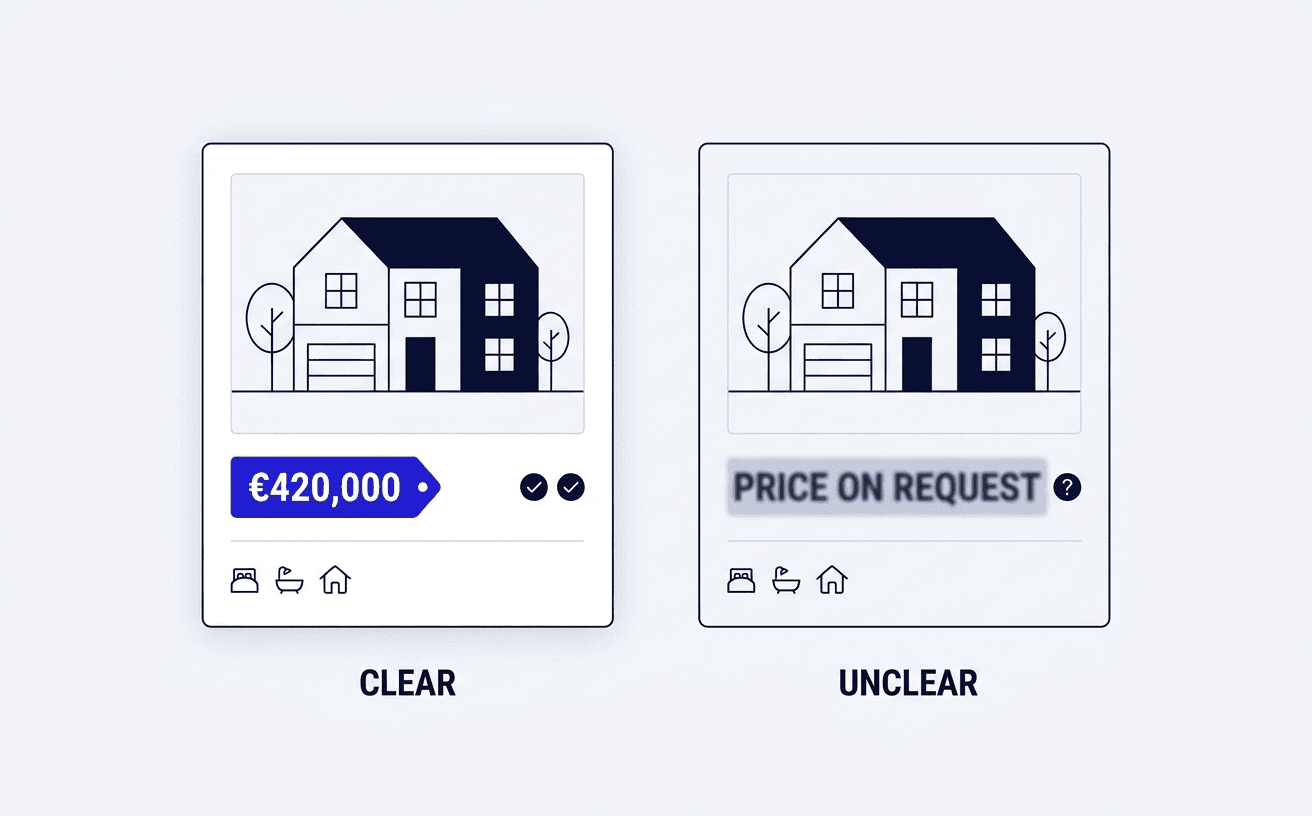
There's a particular kind of listing that quietly costs developers sales: the one where the price is "available on request." It feels safe. It keeps the negotiation in your hands. And it sends a meaningful share of serious buyers straight to a competitor who told them the number.
Off-plan buyers are already taking a leap of faith. They're paying for something they can't walk through yet. Asking them to also chase you for the most basic fact about the unit adds friction at the exact moment you want none.
Worth remembering, too: "price on application" rarely hides anything. Most portals still need a numeric figure behind the scenes to slot a listing into the right search band, so a determined buyer can usually infer the range anyway. What POA actually removes is the buyer's ability to self-qualify at a glance — and that convenience was working in your favour.
Why ambiguity reads as risk
When a buyer can't see a price, they don't think "I'll enquire." They think "this is probably more than I can afford" or "they're hiding something." Neither is necessarily true. But the buyer fills the silence with the least flattering explanation, because that's what people do with missing information about money.
There's a regulatory dimension worth knowing, too. In the UK, National Trading Standards and the Competition and Markets Authority have both taken the view that buyers need all material information — price included — to make an informed decision, and that withholding it can fall foul of consumer-protection rules. Whatever the letter of the law in your market, the principle travels: a buyer treats a missing price as information in itself, and the information they read into it is unflattering.
Clear pricing does the opposite. It says: here is the deal, plainly. That plainness is itself a trust signal, and trust is most of what an off-plan sale runs on.
Show the number, then show what's behind it
Transparency isn't only the figure. It's the context that makes the figure make sense:
- What's included: finishes, parking, storage, any fees rolled in.
- What the payment structure looks like across the build timeline.
- How this unit compares to others in the development, so the buyer understands why one costs more than its neighbour.
A buyer who can see how a price was built is far less likely to treat it as a starting point for suspicion. Take a worked example. Two units in the same block are listed at £420,000 and £455,000. On their own, the £35,000 gap looks arbitrary, and the cheaper unit makes the dearer one look overpriced. Spell it out — the higher unit is a corner aspect, two floors up, with the covered parking space and the utility-room upgrade already in the number — and the gap stops being a question. Now the buyer is weighing a corner view against £35,000, which is a decision they can actually make, rather than a discrepancy they have to interrogate.
The same logic applies to what's excluded. If your headline price is bare and the parking, the kitchen upgrade and the reservation fee are all extra, say so on the listing rather than in a follow-up call. A buyer who discovers three additional line items after they've mentally committed to a number feels the sting of a bait-and-switch, even when nothing was hidden in bad faith. State the total, then itemise. The order matters: buyers anchor on the first number they see, so make it the honest one.
How to present a payment plan
For off-plan, the price is only half the question the buyer is really asking. The other half is when do I pay, and what happens if the build slips. A staged plan is one of the strongest reasons to buy early, but only if the buyer can see it laid out.
Show the schedule as a sequence tied to milestones, not a vague "instalments available":
- Reservation — a fixed fee to take the unit off the market, and whether it's refundable.
- Exchange — the deposit due on contracts, typically the largest single step.
- Build stages — any payments tied to foundations, topping-out or first-fix.
- Completion — the balance on handover, and how a mortgage slots in against it.
A buyer looking at £420,000 reacts very differently once they see it as a £5,000 reservation, a 10% deposit on exchange, and the remaining balance only on completion in 2028. The total hasn't changed; the sense of exposure has. Put a plain figure against each stage and a date or milestone beside it. If the plan protects the buyer — deposits held in an escrow or stakeholder account, say — that's a selling point, so name it rather than burying it in the small print.
The objections you're actually dodging
A hidden price doesn't make objections go away; it just moves them to the phone call, where they cost you more time. Handle them on the listing instead:
- "It's more than I can afford." Then a visible price saves you both an hour. The buyer who bounces off the number was never going to complete — you've lost a lead you didn't have.
- "The price will scare people off." If the number itself is the problem, that's a pricing question, not a presentation one. Concealing it doesn't fix an overpriced unit; it just delays the moment you find out.
- "We want to negotiate from a position of strength." A listed price is the position of strength — it's your anchor. Buyers who see it negotiate around it. Buyers who don't assume the worst and negotiate against a number they invented, which is invariably lower than yours.
- "Prices aren't finalised yet." Fair, early in a launch. Publish a "from" figure or a tight range and label it as indicative. A guided range beats silence, and it lets buyers self-select before you've committed a hard number.
What to do when you genuinely can't publish a price
Pricing openly won't suit every unit or every market. Sometimes the number genuinely isn't set — a phased release, a bespoke penthouse, a market where you're deliberately gauging demand before you commit. The mistake is treating "we can't publish the final price" as licence to publish nothing.
You almost always have something you can show:
- A price range for the unit type: "two-beds from £395,000 to £430,000."
- A starting figure with a clear "from," so the buyer knows the floor.
- A per-square-metre rate, which lets the buyer do the arithmetic on any layout.
- The payment structure, even before the headline is fixed — that alone lets a buyer judge affordability.
Whatever you publish, label it honestly as indicative and give the buyer a date when the firm number lands. "Indicative pricing, confirmed at reservation" is a far better message than a blank field, because it tells the buyer you're being straight with them about what's known and what isn't.
Keep it current
A price that's three months stale is worse than no price. If your listing and your sales team disagree on a number, the buyer notices, and every other claim you make inherits the doubt. Whatever system holds your pricing, the published figure and the real one should never drift apart. This is where a listing that pulls from a single source of truth earns its keep — one place to update, one number everywhere, no reconciling a portal, a brochure and a spreadsheet by hand.
A quick pricing-transparency checklist
Before a unit goes live, run it past this:
- Is there a visible price, a "from" figure, or a labelled range on the listing itself?
- Does the headline number state what's included — and flag what isn't?
- Is the payment schedule laid out by stage, with amounts and milestones?
- Can a buyer see why this unit is priced differently from its neighbours?
- Does the published figure match what your sales team would quote today?
- If the price is indicative, does the listing say so and give a date it firms up?
Pricing openly won't suit every unit or every market. But for most off-plan listings, the developers who put the number where buyers can find it spend less time qualifying tyre-kickers and more time talking to people who already know what they're walking into.